
Delta SkyMiles is the frequent flyer program of Delta Air Lines — the largest US carrier by revenue and the operational gold standard. It is also one of the least-valuable major airline loyalty currencies in 2026, a reality that many members have quietly accepted. This guide walks through what the program actually delivers today, where the remaining value lives, and when a different SkyTeam currency or a different program entirely makes more sense.
The one-sentence summary: earn Delta SkyMiles only as a byproduct of flying Delta for operational reasons — never as a primary accrual target.
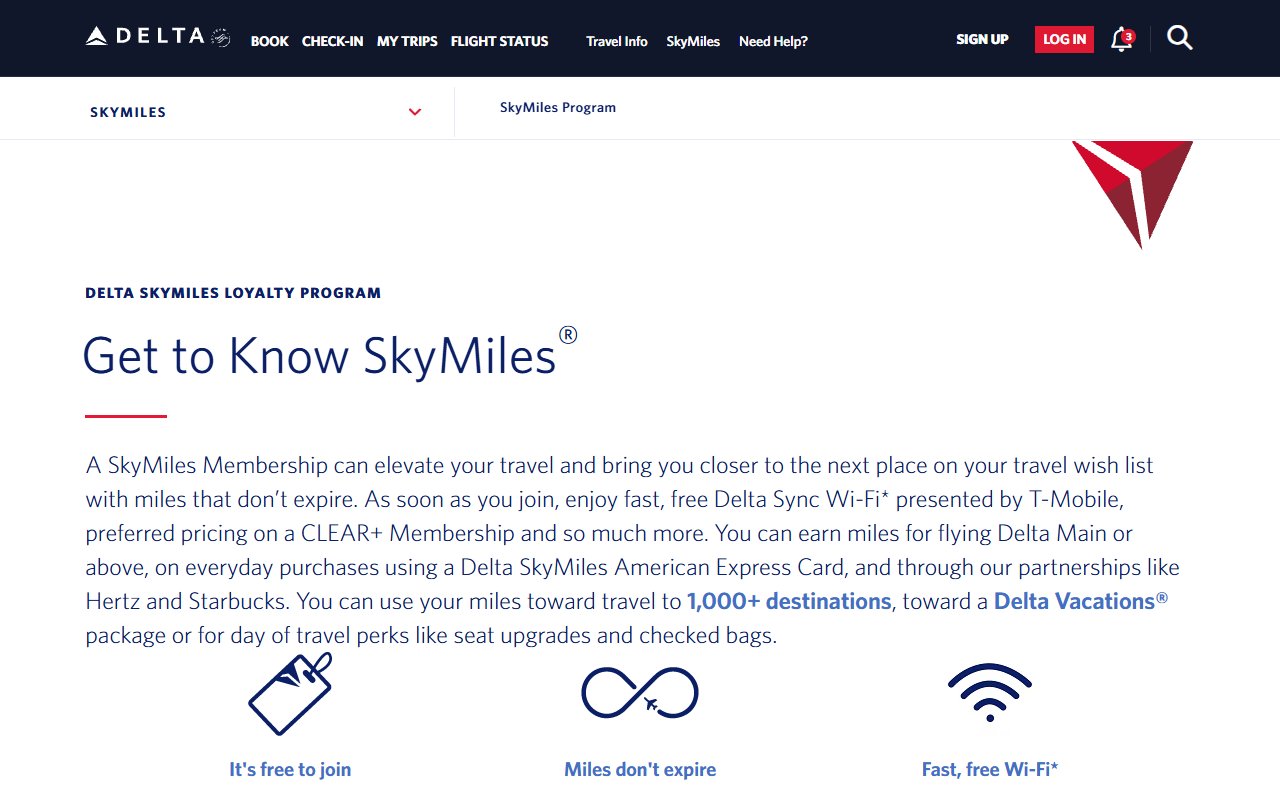
Program at a glance
| Dimension | Delta SkyMiles |
|---|---|
| Alliance | SkyTeam |
| Earning structure | Revenue-based: 5x base per USD, elite multipliers up to 11x for Diamond |
| Award pricing | Fully dynamic since 2015 — no public chart |
| Medallion tiers | Silver, Gold, Platinum, Diamond |
| Qualification (2024+) | MQD (Medallion Qualification Dollars) only — no more MQM/MQS |
| Transferable partner | Amex Membership Rewards (1:1) |
| Mileage expiration | Do not expire |
| Best-in-class card | Delta Reserve Amex — $650 AF, Delta Sky Club access |
Earning structure
Delta moved to revenue-based earning in 2015. Members earn based on ticket price rather than distance flown:
| Status | Miles per USD on Delta tickets |
|---|---|
| General SkyMiles (no status) | 5x |
| Silver Medallion | 7x |
| Gold Medallion | 8x |
| Platinum Medallion | 9x |
| Diamond Medallion | 11x |
Delta's revenue structure punishes cheap-ticket flyers and rewards premium-cabin buyers. A $200 economy ticket earns 1,000 base miles. A $2,500 international business class earns 12,500-27,500 depending on status. For most domestic travelers, Delta earning is modest.
Medallion tiers and the 2024 MQD-only change
Delta revamped Medallion qualification in 2024. Historically, you qualified via MQM (miles), MQS (segments), or MQD (dollars). Since 2024, MQD alone drives qualification. MQM and MQS are retired. Elite qualification is now fully revenue-based:
| Tier | MQD required (2024+) | Key benefits |
|---|---|---|
| Silver | $5,000 | Complimentary upgrades on availability, priority boarding |
| Gold | $10,000 | + 72-hr upgrade windows, Main Cabin Preferred seats free |
| Platinum | $15,000 | + Choice Benefit (Regional Upgrade Cert or 20,000 miles) |
| Diamond | $28,000 | + Delta Sky Club access when flying Delta, 3 Choice Benefits, 72-hour upgrade priority |
For the vast majority of flyers, these thresholds push elite status out of reach without corporate-funded travel or deliberate revenue-maximization. Status is no longer a "road warrior" achievement; it's a high-spend achievement. Many longtime Platinum / Diamond members lost status in 2024 and have not re-qualified since.

Award pricing: the dynamic reality
Delta runs the most aggressive dynamic award pricing of any US major airline. Practical observations from sampling:
- Domestic economy: 10,000-18,000 miles one-way for off-peak short-haul is common. Peak / holiday / popular routes frequently exceed 30,000 miles one-way for the same trip.
- Transcontinental (JFK-LAX): 25,000-45,000 miles in economy, 90,000-180,000 miles in Delta One.
- Transatlantic: 40,000-70,000 in economy, 200,000-400,000+ in Delta One.
- Transpacific: Genuinely punitive. LAX-NRT Delta One frequently runs 400,000-600,000 miles one-way.
The honest ratio: Delta SkyMiles have dropped to roughly 1.1-1.3 cents per mile of typical value at the average redemption, with premium-cabin international redemptions frequently below 1 cent per mile. This is the lowest average per-mile value among major US airline currencies.
The SkyTeam partner arbitrage
Where Delta SkyMiles regain some utility is booking SkyTeam partners. Partner award pricing is often (though not always) saner than Delta metal pricing for the same route. Notable examples:
- Korean Air partner awards. 75,000 SkyMiles one-way in economy between the US and Asia on Korean Air metal. Dramatically cheaper than Delta's own transpacific pricing.
- Virgin Atlantic partner. Transatlantic economy typically 35,000-55,000 SkyMiles on Virgin metal, which is cheaper than Delta metal on the same route during peak periods.
- Air France / KLM partner. Transatlantic pricing through Delta is usually more expensive than booking the same segment directly through Flying Blue — but Delta sometimes has availability that Flying Blue doesn't show.
The catch: SkyMiles partner award search on delta.com is glitchy. Many partner awards that appear on other booking engines don't appear on Delta's. Calling the SkyMiles desk to ticket manually is often necessary.
Delta vs other US majors (frequent flyer lens)
| Factor | Delta SkyMiles | American AAdvantage | United MileagePlus |
|---|---|---|---|
| Award chart | No (fully dynamic) | Hybrid (some fixed partner rates) | Dynamic for UA; fixed for some partners |
| Alliance | SkyTeam | OneWorld | Star Alliance |
| Hub structure | ATL, DTW, MSP, JFK, LAX, SLC | DFW, CLT, PHX, MIA, ORD | ORD, EWR, DEN, IAH, SFO, IAD |
| Sky Club / club access | Diamond or Reserve card ($650 AF) | AAdmirals via Executive Platinum or Citi Exec card | United Club via Club Infinite card ($595) |
| Best partner sweet spots | Korean Air to Asia, Virgin transatl. | Cathay to Asia (via CX Asia miles), QR to everywhere | ANA to Japan, Lufthansa to EU, Singapore to SE Asia |
| Transferable points pipeline | Amex MR only | Bilt (1:1), occasional Citi TY promos | Chase UR (1:1), Bilt (1:1) |
Who should use SkyMiles as primary
- Delta hub residents. If you live in Atlanta, Detroit, Minneapolis, Salt Lake City, or (increasingly) New York JFK and fly more than 30 times a year, SkyMiles is unavoidable — just know the math.
- Sky Club regulars who hold the Reserve. The Sky Club network is genuinely the best US airline lounge footprint; if you value club access, the Reserve card pays for itself on ~30 annual Sky Club visits.
- Corporate travelers on Delta corporate contracts. Your employer's bulk discount eats most of the "SkyMiles are worth less" problem because you're not paying out of pocket anyway.
Who should skip SkyMiles as primary
- Flexible flyers who route across alliances — the revenue-based earning and dynamic award pricing compound to make SkyMiles the worst per-dollar accrual among US majors.
- Premium-cabin redeemers — transpacific Delta One pricing is punitive; use Virgin Atlantic, Alaska, or ANA Mileage Club for the same seats at 30-50% cheaper.
- Transferable-point optimizers — only one bank (Amex MR) transfers to Delta. Every other US major has more transfer partner options.
Power user tactics
- Transfer Amex MR only during bonus windows. Delta runs periodic 15-25% transfer bonuses from Amex MR (typically 2-3 times per year). Without a bonus, the 1:1 ratio on a currency worth 1-1.3 cents per mile is weak.
- Use SkyMiles for SkyTeam partners, never for Delta metal. Korean Air to Seoul in business for 120,000 SkyMiles is genuinely good. Delta One LAX-HND for 450,000 is catastrophic.
- Book "Flash Sales." Delta runs periodic award sales with ~40% reductions on specific routes. Follow @DeltaDeals accounts or opt-in to promo emails.
- Leverage partner availability search tools. Delta.com's partner search misses 30-40% of available partner awards. Tools like ExpertFlyer or Point.me reveal partner availability Delta's site hides; call the SkyMiles desk to book.
- Maximize Companion Certificate usage. The Delta Platinum Amex and Reserve Amex both issue annual domestic Companion Certificates. They're worth $400-900 if used on a priced-up route; they go unused ~60% of the time.
Common pitfalls
- Building large SkyMiles balances. SkyMiles devalue roughly 5-8% per year on average. Balances above 200k-300k miles should be aggressively deployed, not held.
- Booking Delta One with SkyMiles. The math is nearly always terrible. Use Virgin Atlantic miles (transferable from 5 US banks) instead.
- Chasing Medallion status for the upgrade benefit. Upgrade hit rates on popular routes (JFK-LAX, ATL-LAX) are under 20% even for Diamond. The math rarely works for leisure flyers.
- Not registering for global promos. Delta runs periodic 50% off award bookings and 2x-3x earning promos; opting into marketing emails captures these windows.
FAQ
Is Medallion status worth pursuing in 2026?
For most travelers, no. The MQD-only qualification (introduced 2024) prices Medallion status out of reach for discretionary leisure flyers. Unless you're on a corporate travel contract that pushes $15k-28k in Delta spend, the time and spend pursuit doesn't pay.
What's the single best SkyMiles redemption?
Korean Air partner economy awards: 75,000 SkyMiles round-trip between US and Korea/Japan. Routinely delivers 1.8-2.3 cents per mile — the best value available through SkyMiles in 2026.
Are SkyMiles worth more than cash-equivalent?
Functionally no. Delta's "Pay with Miles" feature fixes redemption at exactly 1 cent per mile. Since dynamic award pricing often produces redemptions at 1-1.3 cents per mile, the two are usually within a rounding error of equal.
Can I use SkyMiles on British Airways or Emirates?
No. Delta partners only with SkyTeam carriers plus Virgin Atlantic. British Airways is OneWorld (book with American or Alaska). Emirates does not partner with any US carrier.
Does the Delta Platinum card make sense if I only fly Delta a few times a year?
Probably not. The $250 annual fee is justified mainly by the annual Companion Certificate and Main Cabin Preferred selection benefits. If you fly Delta fewer than 3 trips annually, the lower-fee Delta Gold Amex covers the basics (free checked bag, priority boarding) more efficiently.
What happens if Delta leaves SkyTeam (speculative)?
Delta has no stated intention of leaving SkyTeam, but the alliance structure is softer than Star Alliance or OneWorld. Delta's most important partner (Virgin Atlantic) already left SkyTeam-exclusive arrangements. The practical impact for members has been minimal; it's a structural concern worth monitoring but not actioning on.
Last verified April 2026. MQD thresholds and partner availability change periodically — always verify on delta.com before high-value redemptions.