
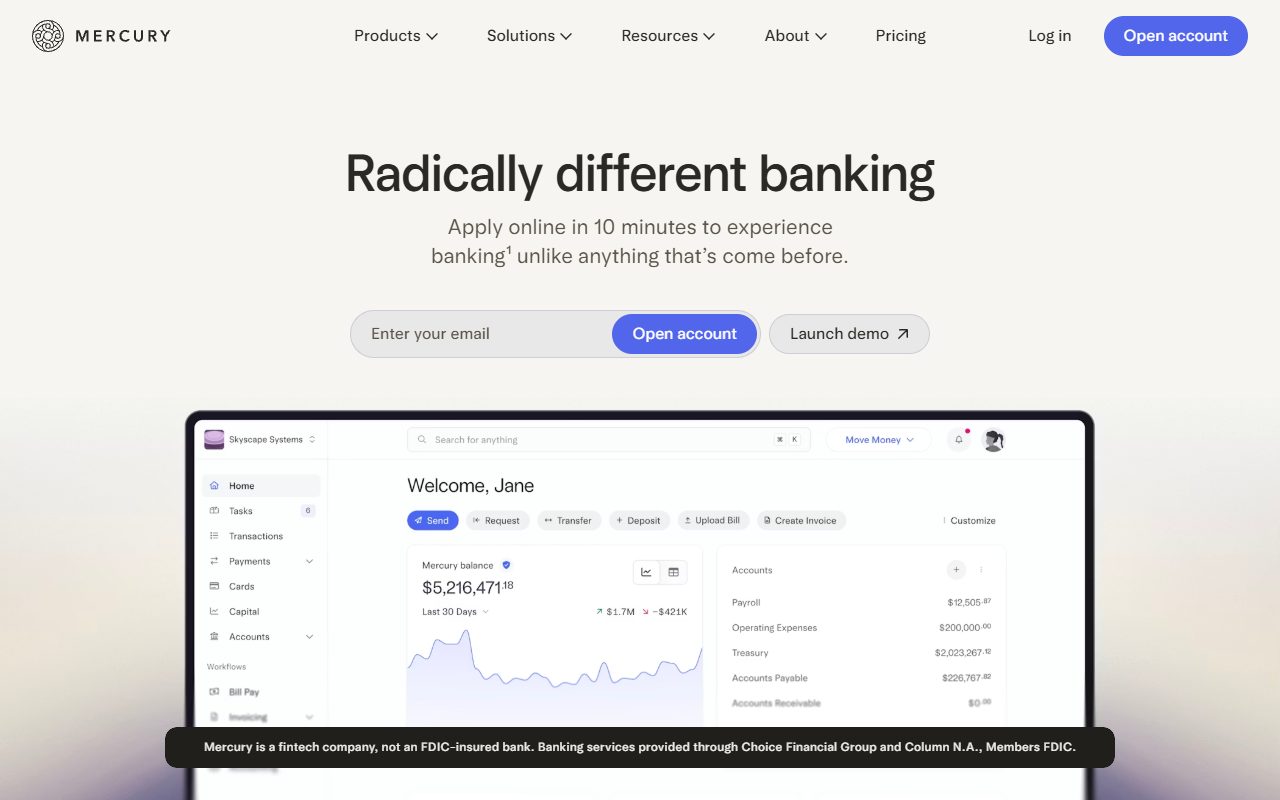
Mercury is a US business banking platform that has become the default banking choice for startups — from solo indie founders to VC-backed Series B companies. Strictly speaking, Mercury isn't a bank; deposits are held at FDIC-insured partner banks (Choice Financial Group and Evolve Bank & Trust). Operationally, it functions as a bank for most practical purposes.
Why Mercury became the default
Three factors: remote onboarding that works for non-resident founders, zero monthly fees with no minimum balance, and a product that treats founders as the primary user rather than as an afterthought. In a category where Chase Business Banking assumes you'll walk into a branch and the traditional options charge $15-25/month for basic accounts, Mercury removed both friction points.
What you get
- Checking accounts with no monthly fee, no minimum balance.
- ACH transfers free, including same-day ACH.
- Wires — domestic wires free, international wires at reasonable fees.
- Check deposits via mobile camera.
- Debit cards for team members with per-card spend limits.
- Plaid integration for accounting tools (QuickBooks, Xero, Bench).
- API access — Mercury has a developer API for programmatic account management.
- Mercury Treasury — automatic sweep of balances above $500k into money-market funds backed by T-bills.
Who Mercury accepts
Mercury approves US-registered LLCs and C-Corps, including those with non-US founders as members/owners. The approval process is remote — passport, EIN, formation documents, a short description of the business. For Wyoming or Delaware LLCs with non-resident founders, Mercury is the most reliable remote-onboarding option available in 2026.
Approval typically takes 1-3 business days once the EIN is in hand. Applications submitted before EIN receipt are paused until the EIN arrives. Some applications get kicked to manual review, adding a week or two — usually related to business description unclarity or founder identity verification.

Mercury Treasury — the quiet upgrade
If your business accumulates meaningful cash ($500k+), Mercury Treasury automatically sweeps excess balances into money-market funds (Vanguard Federal Money Market, among others) invested in short-duration US Treasury securities. Current yields track the Fed funds rate. For cash sitting in operating accounts at 0%, this is a real upgrade — and it's automatic once you're over the threshold.
What Mercury doesn't do
- No cash deposits. No branches. No walking up to a teller with cash.
- No physical presence at all. Support is chat + email. Phone support exists but is email-first.
- International payments are functional but not Mercury's specialty — Wise Business complements Mercury well here.
- Credit facilities are limited. Mercury doesn't offer lines of credit, business loans, or credit cards to the breadth that traditional banks do. Brex and Capital One Spark are the common pairings for credit.
Mercury vs the alternatives
| Mercury | Relay | Brex | Chase Business | |
|---|---|---|---|---|
| Monthly fee | $0 | $0 | $0 | $15 (waivable) |
| Non-resident friendly | Yes | Yes | Yes (w/ funding) | Hard |
| Remote onboarding | Yes | Yes | Yes | No |
| Treasury/MMF sweep | Yes | No | Yes | Yes |
| Credit card | No (limited) | No | Yes | Yes |
| Branches | None | None | None | Extensive |
The typical stack
Most non-resident founders pair Mercury with Wise Business: Mercury as the primary operating account for US revenue and expenses, Wise for multi-currency receipts from international customers and outbound payments to international contractors. This combination solves 90%+ of banking needs at zero monthly cost.
Risks to understand
Mercury is not itself a bank — deposits sit at partner banks that carry FDIC insurance up to $250k per depositor per bank. Mercury has partnership arrangements with multiple banks and "Vault" functionality that can extend practical insurance coverage beyond the basic $250k ceiling. Still, founders holding multi-million-dollar balances should understand this structure and not assume Mercury itself is a bank with unlimited FDIC coverage.
In early 2023, the Silicon Valley Bank failure affected some Mercury customers whose deposits were held at SVB. Funds were recovered without loss (thanks to the federal backstop), but the episode surfaced the risk of deposit-taking platforms relying on single partner banks. Mercury has since diversified bank partners materially.
Who Mercury is for
- US startups of nearly any scale up to late-stage.
- Non-resident founders with US LLCs or C-Corps.
- Indie founders who want zero-fee banking without branch hassles.
- Businesses that already run accounting in Plaid-connected tools.
Who should look elsewhere
- Cash-heavy businesses (retail, hospitality) — you need branch deposits.
- Founders who need business lines of credit on day one — Brex or traditional banks.
- Non-US entities — Mercury is US-only. Wise or Revolut Business for international entities.
- Enterprises needing relationship-managed banking — JPMorgan, Silicon Valley Bank (post-recovery), First Republic-successor banks.
FAQ
Is Mercury actually safe?
Deposits are FDIC-insured up to the standard $250k per depositor per bank. Mercury's multi-bank partnerships and Vault product extend practical coverage further for customers who opt in. For operating balances under $250k, it's as safe as any bank.
How fast can I open an account as a non-resident?
Typically 1-3 business days after submitting the application, assuming EIN is in hand. Some applications take 1-2 weeks in manual review. Have your formation documents, EIN letter, and a clear business description ready.
Can Mercury fund a new non-resident founder's first company?
Mercury's paid plan (Mercury Plus, ~$35/month) unlocks additional features but not extra credit. The Venture Debt product exists for later-stage companies. For indie founders, Mercury is an operating account, not a capital source.
Does Mercury issue a corporate credit card?
Mercury IO launched in 2023 as their corporate card product, available to customers meeting revenue or funding thresholds. For founders who don't qualify yet, pair Mercury with Brex or Capital One Spark for card needs.
What if I need cash deposits?
You can't do this through Mercury. The workaround: keep a secondary Chase Business or local-bank account for cash deposits, sweep to Mercury periodically. Most online-first businesses don't need cash deposits at all.
Last verified April 2026.